Showing posts with label Best Episodes. Show all posts

Tuesday, 25 October 2011

The Best of Doctor Who: The Eighth Doctor

Well this should be easy. Paul McGann, the Doctor for one night only. What's his best story then?

Well, I could cheat and consider media other than TV, in which case I'd go for the animated version of the Douglas Adams story Shada that he voiced.

But no, I'll have to play fair and nominate the story known only as Doctor Who The TV Movie. This was an attempt to revive the series by setting it in the USA, something it notably failed to do.

It's not so much that the story is actively bad, it just has a complete absence of anything good in it. This is Doctor Who by numbers with lines such as "Would you like a jelly baby?" (groan), "Don't mind him he's English" (cringe) and "I'm half human" (roll around on floor going 'nooooooooo!').

Eric Roberts makes a passable villain, although he's clearly not The Master, and Daphne Ashbrook makes a passable companion.

There's certainly been worse stories on US television, but is it Doctor Who? Only just. Yes there's a blue box, but where is the multi-layered plot, the monsters who turn out to have hearts of gold, the moral dilemmas etc etc.

But enough of the plot, what about McGann? Well, before I answer that lest have a quick recap of the debut stories of the various Doctors. William Hartnell was of course perfect from the word go, Patrick Troughton's first outing is, alas, lost forever whilst Jon Pertwee spent most of his first story out cold in a hospital bed. Tom Baker left us for a while in the TARDIS leaving Sarah Jane to carry the story whilst Peter Davidson spent most of his debut in a box. The less said about the intial appearances of Colin Baker and Sylvester McCoy the better.

So you'd have to say McGann's debut performance was probably the best since The First Doctor's thirty three years earlier. He was The Doctor straight out of the box. Debonair and romantic, he could have been the best of Doctor Who. Instead he will remain a one hit wonder.

The Best of Doctor Who: The Seventh Doctor

If any actor who played the Doctor has grounds for asking for his money back its Sylvester McCoy.

Originally recruited to clown around with Bonnie Langford in a series of embarrassingly bad episodes, it seems he'd been taken on by an out-of-touch production team to see out the twilight of the series in some pre-CBBC slot for adolescents who haven't the energy to change channels. It was so bad you really did want to hide behind the sofa.

But then Andrew Cartmell took over as script editor. He couldn't save the write off that was McCoy's first series, but for the show's 25th anniversary series he got to work on his Master Plan. Out went the comedy Time Lord and Bonnie Langford, and in came a darker Doctor and a companion with a back story.

Now you can argue that if you were going to do this you wouldn't really want to do it with actors of such limited range as McCoy and Sophie Aldred, but that's what happened and, to be fair to the two leads, they did their best and, if nothing else, their genuine affection for each other did show through.

McCoy's second season began with a bang with Ben Aaronovitch's Remembrance of the Daleks, which took us back to Foreman's Scrap Yard in 1963, gave us duelling Dalek factions in league with the National Front and introduced us to UNIT's forerunner The Intrusions Counter-Measures Group.

The series then went off the rails a bit before coming back strongly with the pointless, baffling but wonderfully surreal Greatest Show in the Galaxy. Don't ask me what it's about, but menacing kites and a killer bus conductor work for me.

McCoy's third series though was his best. Four top notch stories and not a bad episode amongst them. The show had been throwing up at least one utterly cringe worthy script a year since Tom Baker hung up his scarf, so this was the best series since the Key to Time.

First there was Battlefield, a welcome return for UNIT and the Brigadier as they fight an honourable foe in the form of Jean Marsh's Morgaine and her dimension shifting knights. Fortunately UNIT are all tooled up with their new ass-kicking female Brigadier and a range of bullets for all eventualities.

Then there was Ghost Light, which was very much in Sapphire and Steel territory being set in a Victorian mansion populated by strange characters and evolutionary throwbacks.

Next we had The Curse of Fenric, set in Northumberland in World War II and featuring code breakers, a Viking curse, Russian commandos, vampires, Nicholas Parsons as a consience troubled vicar, and lots of hints that the Doctor is now 'more than just a Time Lord'. Okay, so it was a vampire story filmed during the day due to technical limitations, but it really was on location in the north of England (Yorkshire standing in for Northumbria).

Finally there was Survival, in which Anthony Ainsley as The Master finally stops doing a poor impersonation of Roger Delgado and becomes the feral predator I suspect he always wanted to play.

And that was that. Literally. The BBC canned the series and it was all over.

So what's the best Seventh Doctor story then? Well I'd have liked it to have been Battlefield, but the pacing is a little uneven thanks to it being stretched from three episodes to four episode and the knights look cheap (because they were). Still it was nice to see old Lethbridge-Stewart doing all right, married to the previously invisible Doris and living in a huge mansion. How he paid for it I've no idea. Maybe he pocketed a few of the gold bullets.


So the winner has to be The Curse of Fenric. Had it featured a more iconic Doctor and a more iconic monster it would be a contender for the best ever story, I'm sure. Watching it now I realise that thanks to Cartmell the jump from the old series to the new wasn't that great after all.

With a contemporary theme (pollution), the Doctor hovering in the background letting his companion do all the work and poor old Ace gets put through the emotional wringer, this could have been an RTD script. But whereas the new series likes to paint it characters in black and white, here we are in shades of grey again and there is no Ghost in the Machine ending, but instead a complicated denouement that I would explain to you if only I could remember it.

Shortly after broadcast Doctor Who was no more, but at least the old series went out on a high.

The Best of Doctor Who: The Sixth Doctor


Colin Baker - he was the crap one right?

Wrong. He was the loud one, the fat one, the one worst served by the BBC in terms of stories and production values, but he was a pretty good Doctor. Egotistical, boastful, verbose, unpredictable and occasionally violent, he was a bit different from his predecessors.

Colin Baker got the role on the basis of a scenery chewing performance in Blake's 7 and a speech at a wedding. The costume is, admittedly, a disaster, but that was imposed on Baker by John Nathan-Turner, a producer who had really lost the plot by this stage.

So dressed like a wally Colin Baker had to navigate some of the worst Doctor Who stories ever written. Is there any point in watching?

Well yes, because of all the actors who flew the TARDIS, none could deliver a comic line better than Colin Baker, and given some of the guff he was asked to act in, you need a good laugh.

However if I want you to love Colin Baker there's no point in going over episodes like The Two Doctors, in which the welcome return of Patrick Troughton and Frazer Hines was ruined by a dull script, or Timelash in which Paul Darrow from Blake's 7 returns the favour to Baker by putting in an OTT performance, but looses the battle against risible sets and dire special effects.


Instead lets go straight to the highlight of Colin Baker's brief tenure; Revelation of the Daleks.

Like all the best Dalek episodes, the metal dustbins are kept in the background for most of the story. Instead we have a complex series of at least five overlapping subplots, set around a cryogenic storage facility for the dead rich.

Davros is secretly making a new Dalek army from bits of dead humans (hmm, so that's where RTD got the idea from ...). Meanwhile we also have Orsini and Bostock, an errant knight and his squire on their way to assassinate Davros. Then we have the to rival Dalek faction out to get Davros too and whilst all this is going on we have bodysnatchers, some dodgy food production, power struggles in the management structure and a loopy DJ.

An idea of what we have in store is given when one of the characters comments on recently departed client "I hope we're on time, she's already beginning to froth." After that the killer lines come fast and furious. The founder of Alternative Comedy, Alexi Sale, plays the DJ, but it's a credit to the rest of the cast, who deliver the blackest of lines with deadly seriousness, that he isn't the funniest.

The best double act of all though is the Doctor and Peri. Colin Baker and Nicola Bryant always sparkled when together. Take the fob watch scene - you have to see it to appreciate it - which shows how good they are at spinning out even the weakest of puns.

The only down side to putting Revelation forward as his best adventure is that he's barely in it. There's so much going on that he's periferal to most of the story, and in the end Davros's empire more or less falls apart under its own contradictions, rather being brought low by some inexplicable special ability of the Doctor and/or the TARDIS. But that's another reason I like the story - it's realistic, that's how Dictatorships usually end.

If every Sixth Doctor story had been this good we'd all be singing the praise of Colin Baker as one of the great Doctors.

Alas they weren't.

However the Sixth Doctor has gone on to a long and productive second lease of life in books and audio releases, and Colin Baker has had the pleasure of being voted the best audio Doctor of all. He has even, thanks to the animated webcast Real Time, obtained a costume worthy of his character. All of which must be some compensation for being so diabolically treated by the BBC.

The Best of Doctor Who: The Fifth Doctor


We're now in 1981, and properly into the John Nathan-Turner years.

Now before I go on I should saw that Doctor Who fans owe a considerable debt to the man who produced the series for the whole of the 1980s. Without him the show would probably have died a death shorty after Tom Baker hung up his scarf, and if that had happened it's hard to see the show eventually coming back in the way that it did.

However what Nathan-Turner actually did with the show was not good. By executive order he removed all elements of magic, myth and horror, banned his actors from humour or ad-libs, disintegrated the sonic screwdriver, reduced the Doctor to a rather helpless victim of events, and extracted the show from its regular Saturday teatime slot. So with everything that made the show good expunged, I switched off.

So Peter Davidson isn't my favourite Doctor then. A good actor, Davidson might have made a great Doctor had he been a little older, served with better scripts, and been allowed to play the character the way he wanted to. Choosing the best of the Fifth Doctor stories then isn't going to be too hard, as there are only really two I'll watch again.

I suppose in passing I should mention Kinda, very meaningful but don't ask me what it means, and The Black Orchid, very atmospheric but a bit ridiculous, but as I've not watched either in nearly thirty years I can't really say more.

I'm tempted to give the award to The Five Doctors. The plot isn't great. It couldn't be otherwise really as Terrance Dicks had to cram in so many Doctors and Companions that by the end the latter are reduced to doing nothing more than standing around and shaking hands with each other. But it does have a sparkling performance by Patrick Troughton, an enjoyable turn by Jon Pertwee and Richard Hurndall in the role-of-his-life as the First Doctor. It also has Tom Baker who, even in some out-of-context footage from the aborted Shada, easily out Doctors his successor.

The story can also claim what may be the best battle scene in the old series, when the Raston Warrior Robot obliterates a cyberman patrol - Doctor Who isn't usually remembered for squirting innards and severed limbs. The cyberman are otherwise total crap in this episode, as they are throughout the 1980s, but they do at least die spectacularly well.

Considerably better is The Caves of Androzani. Robert Holmes again comes up with interesting characters and Peter Davidson actually has some acting to do, possibly because Holmes didn't understand his Doctor and wrote as if for Tom Baker.

Davidson starts off in typically wimpish form with lines like; "What do we do now - Surrender." and "How do we get out of this - I really have no idea." And he has to be rescued from his own execution by a villain of all people. However by episode three he seems to have grown some balls and manages to eventually rescue Peri and save the day.

But even better is Enlightenment. I've had my doubts about including Special Editions with new effects, but as in this case all they've done is replace first rate model work with second rate CGI the difference isn't huge. Enlightenment takes what the BBC can do well, acting and historical sets, and runs with it. There are no planet invading monsters just the enigmatic Celestials and - unfortunately - the Guardians. 


Lynda Baron (nurse Gladys Emmanuel from Open All Hours) flirts with Turlough whilst wearing thigh length boots and Tegan is only mildly irritating. The result is enigmatic and interesting, something Doctor Who rarely managed during the eighties.

The Best of Doctor Who: The Fourth Doctor

Ah, the Tom Baker years, and Doctor Who reaches heights never attained before or since.

And depths too, to be honest, but we'll forget about that.

The curly one started off with a few earth based stories left over from the Pertwee years, then blasted off into space for a series of Gothic horror film remakes that are amongst the best of the series. He then said good by to the earth and ditched his last human companion to search for the Key to Time.

Then things started to go a bit wobbly. They gave the job of script editor to a zany comedy writer - a very brave move. The seventies then came to an end, Douglas Adams left to become a demi-god, and a new script editor was appointed to vowed to end all the "late sixties hippie ideas derived form Third World cultures" which had infested the series. Arguably it was all downhill from there.

But back to the highlights, and what a lot there are.

There's Terror of the Zygons with its atmospheric Scottishness, although it does have a terrible CSO monster and the Brigadier in a kilt. It would certainly be a candiadate for best UNIT story, except by this stage UNIT was played out. 

Then there are the best of the horror remakes; The Pyramids of Mars and The Brain of Morbius, both of which also have the incomparable Sarah Jane.

Another near-perfect story is The Robots of Death. Agatha Christie in space with a claustrophobic setting and wonderfully scary Regency-style robots.

The Talons of Weng Chiang, a tribute to the best of Victorian noire is another near winner. A collection of cliches from swirling fogs to inscrutable Chinese, giant rats in the sewers and sneaky oriental assassins, it also has some of Robert Holmes's most sparkling dialogue, not just from the Doctor and Leila, but also from a great cast of supporting characters. Brilliant stuff if you ignore the racism, but you can't really. 

The Key to Time was an interesting concept for the next series. Alas, it didn't produce any classic episodes, but Mary Tamm looked superb and easily gets the prize of best dressed companion. If her Ice Maiden costume doesn't tickle your fancy, then just look at her mock-Medieval outfit for The Androids of Tara. Personally I think Tom Baker (and Richard Dawkins) married the wrong Romana.

The Douglas Adams years tend to divide fans, and I'm not completely in the camp that thinks he was the best thing that ever happened to Who, but The City of Death is very funny, very stylish thanks to being shot in Paris, and actually a very original idea.

Shada doesn't count as it was never broadcast, but I also suspect it wouldn't have been as great as many fans expect. I mean, it includes the Doctor on a bicycle being chased by a flying globe. How rubbish would that have been?

As I've said, Tom Baker's last season was a bit uneven, but there's he no doubt he went out on a high. Logopolis is an interesting story, as The Doctor comes up against his most deadly enemy to date, namely entropy. Baker acts his socks off here, and the final fall from Jodrell bank is a fittingly dramatic way for it all to end.

So what's the best of the Fourth Doctor then?

Well it was almost The Genesis of the Daleks. Here we have Doctor Who at its peak: Tom Baker, Liz Sladen, Ian Marter, a Terry Nation script, the Daleks, Davros, the camp chap from Allo Allo in a minor roll, they're all there.

Why doesn't it win? Partly I suppose I've watched it so many times it's lost some of its fizz, partly its a touch too long, partly I have my doubts about the point it's trying to make - is genocide really that bad when we're talking about the Daleks?

Mainly though its because I prefer dark humour to deep thought.

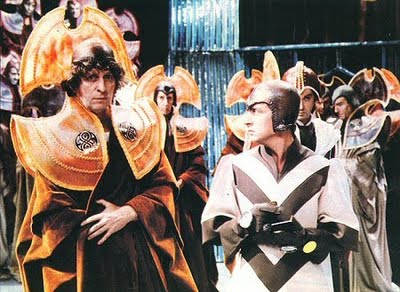
So my vote for the Best of the Fourth Doctor goes to The Deadly Assassin, Robert Holmes's deliciously satirical political thriller set on Gallifrey.

The Time Lords had been on the periphery of the Doctor Who universe for a while. We'd had sneaky peaks in The War Games and The Three Doctors, but now we were going to find out the whole truth. All seeing, all powerful and supposedly all good, they could have been stupefyingly boring, but not in Holmes's capable hands.

Instead of the vaguely Buddhist ascended masters hinted at before, here we had a bunch of old fuddy-duddies who can now barely work the technology they have inherited and who now care more for status and tradition that science and art. No wonder there are so many renegade Time Lords.

The set design is spectacular, the acting first rate and then there's The Matrix, an idea so good someone else had to make a film about it.

But most of all what makes it great is the script. With ideas nicked from The Manchurian Candidate and Porterhouse Blue, and contemporary references to Harold Wilson's resignation and the Kennedy assassination, Holmes created a masterpiece leavened with his inimitable dialogue.

Then there's the ending. The Master is defeated, Gallifrey is saved, so what do the Time Lords do? The embark on a cover up of course. Delicious, simply delicious.

A classic episode from a classic Doctor.

The Best of Doctor Who: The Third Doctor

Ah, now we're getting somewhere. It's 1970, Doctor Who goes colour and Jon Pertwee takes the reins and to cap it all I'm born! (Three days before the first episode of The Ambassador's of Death to be precise).

Its difficult to know what the BBC thought they were getting when they signed up Pertwee, a comedy actor who'd had bit parts in Carry On films. Probably not the dandy action man they actually got anyway.

The Pertwee years pretty much exactly coincide with height of Glam Rock and Ted Heath's government. There is certainly a touch of glam to the debonair Third Doctor and his frequently patronising attitude makes him a bit of a Tory too.

Then there are the obsessions of the era. Five stories concern energy sources (The Silurians, Inferno, Claws of Axos, The Three Doctors, The Green Death, The Monster of Peladon), three are about nuclear war or domesday weapons (The Colony in Space, The Mind of Evil, Day of the Daleks) and two are about environmentalists (The Dinosaur Invasion, The Green Death).

As Pertwee is one of my favourite Whos though, the honourable mentions are going to be quite long, so lets crank up Bessie, reverse the polarity of the neutron flow, and get on with it.

Firstly there's the debut story itself, Spearhead from Space, which gave us the Autons and the classic scene of the dummies gunning down hapless shoppers. UNIT get their colour debut to and whilst the Brigadier's gang often appear to have been reduced to little more than a flag party and have lost their sixties gizmo's, they do contribute to a significant amount of gun play and enjoyable mayhem for the rest of the Third Doctor's tenure.

The first season also ends with a cracker too in Inferno, which features the destruction of a parallel earth and a baddy Brigadier. Overlong and overrated, with the ubiquitous green goo, it's still good, as long as you don't expect it to be the greatest Who ever, which some people will claim.

The next season saw the arrival of The Master, played by the late and great Roger Delgado. Horrendously overused, he started well with Terror of the Autons and the series also contains The Daemons, a story of witchcraft and devilry in an English village which scores ten out of ten for atmosphere, but loses all its points for a silly plot and a useless Doctor.

Once the Third Doctor actually gets to leave earth we have an enjoyable romp in The Carnival of Monsters. In terms of fun this could be the best-of-Pertwee. The one down side was the useless Drashigs. Writer Robert Holmes apparently suspected they'd look awful, so made their name an anagram of dishrags.

Another favourite of mine is The Day of the Daleks, the first story that actually uses time travel as plot device. Hard to believe it took them ten years to use time travel in a story about a time traveller isn't it? A tale of Freedom Fighters from the future trying to change history whilst being hunted by time travelling cyborgs, it does sound a little like a certain Arnie movie doesn't it?

If we were allowed to include Special Editions in this list it might well be a winner. The new effects make the Dalek controlled future look like Blade Runner and give the U.N.IT. versus Dalek fight at the end a suitably epic feel.

It's also quite progressive. This Doctor's reign almost exactly corresponded with Ted Heath's stay in Downing Street and, despite producer Barry Letts being a communist, the Third Doctor didn't spend a lot of time hanging around with the proles. Here though, whilst Jo falls for the propaganda of the Controller, the Doctor diagnoses a very sick future society just by observing the conditions of the workers.

Also the metal dustbins are kept very much in the background until the end, which works. The sink plungers from Skaro were always more effective in the imagination than reality.

Other Pertwee Dalek stories were less good. Planet of the Daleks is a rehash of the original Daleks story, although better made, and Death To The Daleks is an uninspiring H Rider Haggard rip.

Then there's The Three Doctors. Not much to write home about in many ways, but worth while to see Troughton and Pertwee playfully sending each other up and Hartnell's last TV appearance - filmed in his garage as he was too ill to get to the studio. Sad to think that all three are no no longer with us.

Another honourable mention must go to The Time Warrior, which introduced those root-vegetable clones, the Sontarans and the late Liz Sladen as Sarah Jane Smith in a passable medieval yarn.

A better Sarah Jane story though is The Dinosaur Invasion. Now mostly remembered for the lamentable condition of the titular sauropods, it is a good story with some well meaning, but very sinister, eco-utopians as the real villains. Never trust a hippy indeed. Not bad, but you're better off reading the book.

So what the top Pertwee story then? Well it was almost The Curse of Peladon, the story of a primitive planet petitioning to join the swanky Galactic Federation, which by complete coincidence came out just as Heath was trying to get us into the Common Market. Here we have Jo Grant not being completely useless for a change and the plot twist of the Ice Warriors now being goodies.

However for the award of best-of-Pertwee we have to have an earth bound adventure. It also needs to be from his first series, as the Third Doctor, and the series generally, was never again so gritty and serious.

When I first put this post up the winner was  The Silurians, and not just because it's set in Derbyshire. The idea of aliens who have been here all along, and who probably have a better claim on the earth than we do, was a startlingly original one. It's also done really well.

Production values are pretty good and whilst the papermache Allosaurus is a bit of an embarrassment - they had a bit of a problem with dinosaurs in the Pertwee years - the underground base and the caves are greats sets and scenes of the epidemic outbreak at railway station are frighteningly realistic.

There are some familiar faces in the cast including Avon from Blake's Seven as a UNIT officer, Mackay from Porridge as a scientist and Geoffrey Palmer as an administrator.

It's main strength though is Malcolm Hulke's multi layered script. Both factions, the Silurians and the humans, are split into hawks and doves, but unlike in the New Series, they aren't caricatured as good and bad. Major Baker, the leading human hawk, turns out to be genuinely brave man whilst his opposite numbers in the reptile camp are eventually proved right when the Brigadier blows up their caves and wipes them all out.

Written whilst the National Front and the Black Panthers where in the news, this is remarkably even handed and grown up stuff, a million miles from the simplistic "Racism's bad, m'kay?" approach of RTD in the New Series. Instead Hulke created a genuine moral dilemma, with no easy answers.

But then I changed my mind.

True, Silurians is great, but it's not really exciting enough for six episodes and whilst the dark ending is certainly startling, some of the effect is lost when the Doctor turns up working for the Brigadier again next week. What's a little genocide between friends, eh?

That aside though the next story really is one of the best.

The Ambassadors of Death is also very long, but punctuates its three hour running time with so many battles, chases and punch ups that you don't really notice.

Liz Shaw, the first female companion with something other than cotton wool between her ears, gets both to be clever and menaced by a couple hoods in a Ford Capri.

The Brigadier, meanwhile, is far from being the Colonel Blimp he later turns into. A one man killing machine he bumps off at least half a dozen baddies personally with a variety of weapons and none at all. He is also on the ball for a change, both doing what the Doctor says and even finding out a few things for himself, but at the end the Brigadier is happy to let the Doctor sort things out in his own non-violent way. This is the way the Doc and the Brig should always work together.

The aliens-in-space-suits were so effective that Steven Moffat stole the idea for Silence in the Library. The special effects are pretty good for the time too. The space scenes were reused for an abortive series called Moonbase 3 and with a Hammond organ standing in for The Blue Danube in the 2001-style docking scene is a great touch of irony.

The idea of monsters who aren't actually villains is also pretty neat. That a whole galaxy of space faring baddies was queueing up to invade early seventies Britain was one of the least plausible concepts of this period, so it's reassuring to know this lot were really just visiting.

So all told this wasn't bad for my first Who. Strange to think though that I was born into a world where the BBC could put out a show which featured the a British Mars Mission.

What happened to those dreams?

The Best of Doctor Who: The Second Doctor

Like Matt Smith, I do love Patrick Troughton's cosmic hobo, but oh dear oh dear, most of his actual stories are pretty rubbish.


The Second Doctor is at his best in the ensemble pieces The Three Doctors and The Five Doctors, but these are properly Third and Fifth Doctor stories and can't count in this list.

Honourable mentions then are fairly few. There's The Web of Fear, which featured the unlikely combination of Yetis and the London Underground and introduced the redoubtable Colonel Lethbridge-Stewart.

Then there's The Invasion with its scenes of Cybermen marching past London landmarks being battled by, the now Brigadier, Lethbridge-Stewart and the newly formed UNIT, who here are all high-tech with an HQ in C-130 Hercules.

And then there's The Tomb of the Cybermen, a blatant rip off of The Mummy's Curse. When I was young this used to regularly win readers polls as the best episode ever, mainly voted for by people who'd never seen it as it was one of the famous Lost Episodes. Then a copy was found down the back of a filing cabinet and when people actually saw it they found it tedious, repetitive and pointless. And racist. It doesn't win any more.

But amongst all this dross there still has to be a winner, so I'm going to go for The War Games, his last story.

At ten episodes its not exactly a story you sit down and watch in one go. There is also a lot of pointless going over the same ground at a geological pace and the Doctor is rather less than dynamic too. It doesn't help that the story gets its own internal geography messed up too, but there is a lot of atmospheric war-is-hell stuff, which is actually rather exciting.

However the story really gets going once the aliens appear. With hindsight the Companions are a little slow to realise what the boxes that appear with a strange groaning noise, and which are bigger on the inside than on the outside, actually are.

Then there is the appearance of the Time Lords themselves. We'd met the Meddling Monk on William Hartnell's watch, but this was the first time the Doctor's own race had been name checked. And what an information dump we get about them! Of course, it's all old hat now, but back then it was all completely new. Who knew the Doctor had stolen his TARDIS, or that the Time Lords could be such killjoys?

So it may be longer than the Hundred Years War, but it gets there in the end and is a fine way to send off the Second Doctor.

The Best of Doctor Who: The First Doctor

I've managed to keep my inner Nerd at bay on this blog for long enough, so here I go with a run down of my favourite Doctor Who episodes, choosing my favourite episode for each the venerable Time Lords eleven incarnations.

We start then with old grumpy himself, William Hartnell's First Doctor, although I should add he wasn't quite as cantankerous as many people think. He lightened up after the first few shows, but those are the ones people remember. First impressions really are important it seems.

Before we come to the winner of the title of Best First Doctor story, honourable mention must be made of those that didn't quite make it.

The Tenth Planet must be a contender, with the first appearance of the Cybermen and the first regeneration scene. Alas the BBC in their wisdom wiped the tape of the last episode, which rather spoils it.

Flawed but canonically important is The War Machines, with its very sixties titular robots, and the first monsters-versus-soldiers battles. No UNIT yet, but the idea was there.

Then there's The Time Meddlar, staring the bloke from the Carry On films, which introduced the first of numerous renegade Time Lords and also started the trend for casting comedy actors as villains.

A very, very strong candidate is the Dalek Invasion of Earth, with its sinister scenes of a deserted London, which were a dry run for Terry Nation's seminal Survivors, and the metallic compost bins lording it over a conquered humanity aided by their black shirted Robomen.

But even this is trumped by the triumph of the first ever story, 100,000BC. Most of it's a load of rubbish about cave men, but the scene when Ian and Barbara leave behind the drab junkyard of 1963 and enter the TARDIS is fantastic, it's like watching the fifties turn into the sixties before your very eyes. But 100,000BC is not the winner, only the appetiser.

The best of William Hartnell's episodes is without doubt the one that turned the show from being an educational romp through history into a sci-fi phenomena. After three episodes of Ian teaching cave men to make fire we find ourselves in a futuristic city amidst a radioactive forest. Suddenly Barbara is menaced by a sink plunger on a stick - and then credits roll.


This is, of course, The Daleks.

The pepperpots have been done to death since, used and abused for good and ill, but these Dalek's are different. Yes they are cold, yes they are ruthless, they say 'Exterminate' (but not until episode four), but they are not the Nazi stand-ins they later became. Trapped in their Expressionist city amidst the fossilised remains of the world they have destroyed, they are to be pitied as well as feared and are perhaps more familiar than we would like to think.

Outside the city are the Thals, pacifist fashion victims who believe in live and let live until convinced of the virtues of violence by the TARDIS crew, who need to get into the Dalek city to refuel the TARDIS. Ian, at least, gets a twinge of conscience over this 'war for oil' (or mercury), but what is the Doctor's real motivation?

We are never quite sure, which is one of the reason's Hartnell's Doctor is so great.